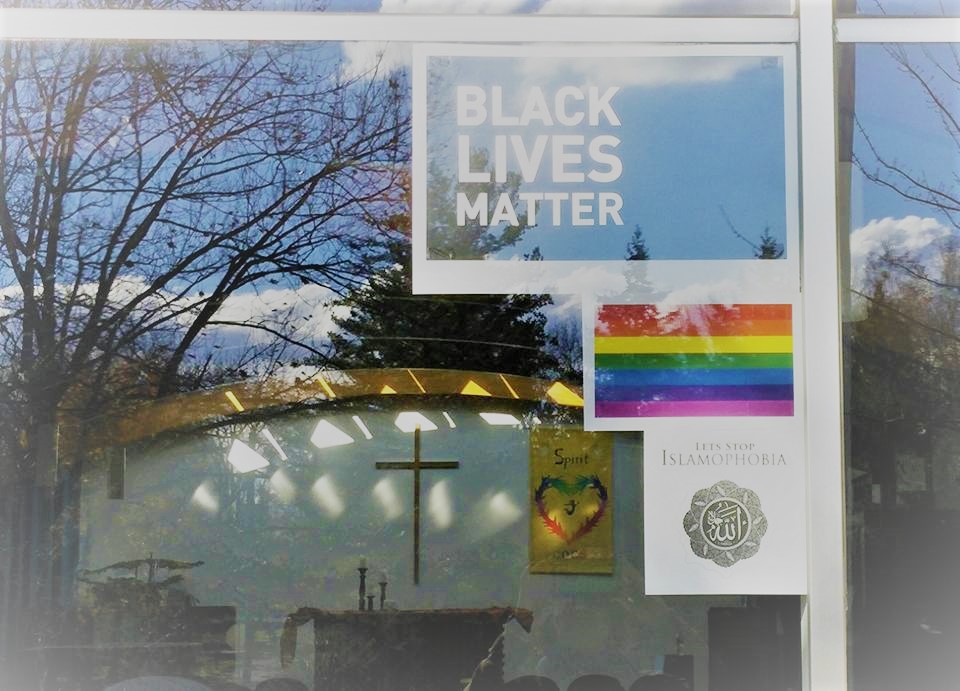
The Unsilent Church:

Reclaiming the church as a great social justice movement maker

  • Pastoral Missive Sent to My Congregation on October 19th

    I wrote this missive at the beginning of the crisis in Gaza, but only sent it to my little congregation. Seems important, as we continue to see devastation in Gaza, to speak this publicly.

    Dear friends-

    When I started seminary at Pacific School of Religion in 1995, I took a class called The Bible and the Near East from a visiting Israeli scholar (Dr. Shalom Paul).  He approached the Hebrew Bible from a comparative literature perspective, and we read other ancient writings from other religions/ethnic groups from around the same time.  It was an interesting approach for sure.

    One lesson that has stuck with me was about “an eye for an eye” that is found in Leviticus:

    19 If someone injures a fellow citizen, they will suffer the same injury they inflicted: 20 broken bone for broken bone, an eye for an eye, a tooth for a tooth. The same injury the person inflicted on the other will be inflicted on them. (Lev. 24:19-21, Common English Bible).

    We have all heard this saying even if we weren’t clear about where the saying came from.  You also might remember the famous Gandhi quote “an eye for an eye makes the whole world blind.”  I have seen that on numerous bumper stickers over the years.  Dr. Paul spent an entire class session talking about what this verse has meant to our Jewish siblings over the millennia as well as how this law was quite unusual in its ancient context.

    According to our Israeli professor, an eye for an eye is not about revenge as one might guess.  An eye for an eye was about setting limits to revenge.  In an ancient context where “justice” was meted out in radically disproportionate ways (i.e. someone stole a piece a fruit and they would lose their whole arm), an eye for an eye was commanding that punishment fit the crime.  It was about a proportionate response to whatever crime or misdeed had happened.  While I do not believe in capital punishment, an eye for an eye regarding killing a human limited the response to only executing the person responsible for the death. Many other laws in that historical context would call to execute the whole family, or destroy the whole village.  Even if it can feel brutal in our context, an eye for an eye was about limiting the retribution, and that was a radical thing in the ancient near east.

    Now, I cannot say with confidence that this interpretation is indeed the dominant interpretation in most Jewish contexts.  As we know, Biblical interpretation can vastly differ from community to community.  But I have carried that lesson with me for almost 30 years and I have been thinking about this so much in the last 10 days…the devastation in Israel/Palestine brings this question up for me in profound ways.

    I have heard many people say, “This conflict is so complicated.”  I have said it in the past as well.  But it is becoming clearer and clearer to me that it is not that complicated.  The Israeli response to the Hamas massacre is beyond an eye for an eye.  It is beyond a proportionate response.  It is beyond “defending” itself.   The government of Israel has dropped 6000 bombs on Gaza in 10 days.  For context, the US dropped 6000 bombs in a year during an active war in Afghanistan.  6000 bombs have been dropped on 2.2 million people living in an area the size of Las Vegas, but with 3 times the population.  Gaza City is more densely populated that New York City.  And unlike any other city in the world, there is nowhere to flee.  Nowhere.

    Yesterday in Washington DC, hundreds of people, mostly American Jews, protested in the capital.  These protesters were lamenting the loss of innocent lives in Israel and those who remain in Hamas custody.  But all of them were calling for a ceasefire.  One protestor said, “Killing Palestinian babies won’t bring back the murdered babies of Israel.”  Israel cannot kill its way out of this conflict, but the right-wing Zionist government of Israel is showing no signs of mercy.

    I have no idea how we get beyond this terrible place. But I do know that a genocide of indigenous people in Gaza and in the West Bank is not the answer.  An Apartheid state for Palestinians is not the answer.  Western colonial expansion is not the answer.  The answer must be rooted in human dignity and agency…or we will never find our way out of this mess.

    Not in our name.  That is what the protestors said yesterday.  Not in our name.

    In love and solidarity,
    Deb


  • Advent Musings–Dec. 5th

    Dear friends—

    Gray, gray go away, come again some other day!  No really, I mean it…go away!

    My view of the Michigan grayness at the public library.

    I don’t know about you, but the Michigan gray is getting to me this week.  It is cold, wet, dark, gloomy (and has been since last Wednesday!) and this is the time of year when I find myself starting to feel heavy and sluggish.  I fight becoming constantly overwhelmed by the desire to crawl into bed for three months.  I start to feel a bit caged and restless while being too tired to do anything about it.  Everything is harder this time of year which is unfortunate because this is a pretty important time of year in my life’s work.  😊

    When I was working out this morning, I lamented the same thing to a friend at my studio and she had an interesting response.  She reminded me that we have 10 days until the days start to get longer, and that although winter will be around for a while, the earth is already making its way to spring.  It is certainly a different way to think about it.  I don’t suddenly feel infused with energy while acknowledging that, but it is a good reminder that we are never stuck in one place.  The earth is always rotating and bringing change to our circumstances, especially here in Michigan.

    On the other hand, what if I am fighting against a natural cycle that we need to go through as humans?  Do bears fight the need to hibernate in the winter?  Maybe they do…I wouldn’t really know since I am not a zoologist…but maybe winter fatigue is something that we aren’t supposed to fight.  Maybe our American lust for productivity and the resulting resistence to rest is the problem.  Maybe I shouldn’t be fighting my tired brain.  Maybe I should be listening to it.  Maybe hunkering down isn’t a bad thing but is a healthy thing.  I “should” on myself quite a bit especially when I am tired or overwhelmed…can anyone relate?

    If you are feeling low energy, you are not alone.  While we all have things we have to do and issues we care deeply about, try to be gentle with yourself, and I promise to try to remember that for myself.  Advent as a sacred season isn’t really supposed to be super busy or productive.  It is supposed to be a time of reflection and preparation.  Just like the last trimester of pregnancy where a pregnant person is overcome with both exhaustion and excitement…we anticipate what the Christ child will bring for us, but we don’t need to be productive to receive the sacred gifts of God breaking into human history in the form a tiny baby.

    Just like we don’t need to be forced into false cheerfulness this season, we also don’t need to succumb to forced productivity.  Rest if you can…

    Love to you all,
    Deb


  • Advent Musings–Dec. 3rd

    Dear friends—

    After the worship service this morning, one of our members said to me, in response to my sermon,  that Advent has an edge to it.  Yes!  I love that way of articulating Advent…it is edgy.  I don’t know where American Christianity got this idea that Advent was supposed to be picturesque and quaint and perfect.  Things are supposed to be decorated just right.  We are supposed to sing the correct music.  We are supposed to be cheerful and happy even though it is dark and cold.  But the fact of the matter, when we stop and think about it, there is nothing quaint about Advent.  Advent is gritty and human and hard to define.  The Christ child didn’t come into this world in a quaint way.  He was born into poverty to a migrant family who were living in a country that was occupied by a militarized empire.  Shortly after his birth, his family had to flee violence, and live as refugees in Egypt.  He was executed by that empire as a young man. Nothing about Jesus was picturesque and cute.  Jesus was gritty.

    If you find yourself resisting the societal forces  to move through Advent like business as usual, know that you are being authentic to the spirit of Advent.  This season feels different, and I believe that it should.  We are different.  The world is different.  Advent has an edge because Advent holds our humanity in all our beauty and ugliness.  Love is alive but so is grief and fear and violence.  Advent can hold it all.

    Love to you all,
    Deb


The Unsilent Church

Proudly powered by WordPress